
Emergency Preparedness in Healthcare Settings
Instructor Led Training (ILT)
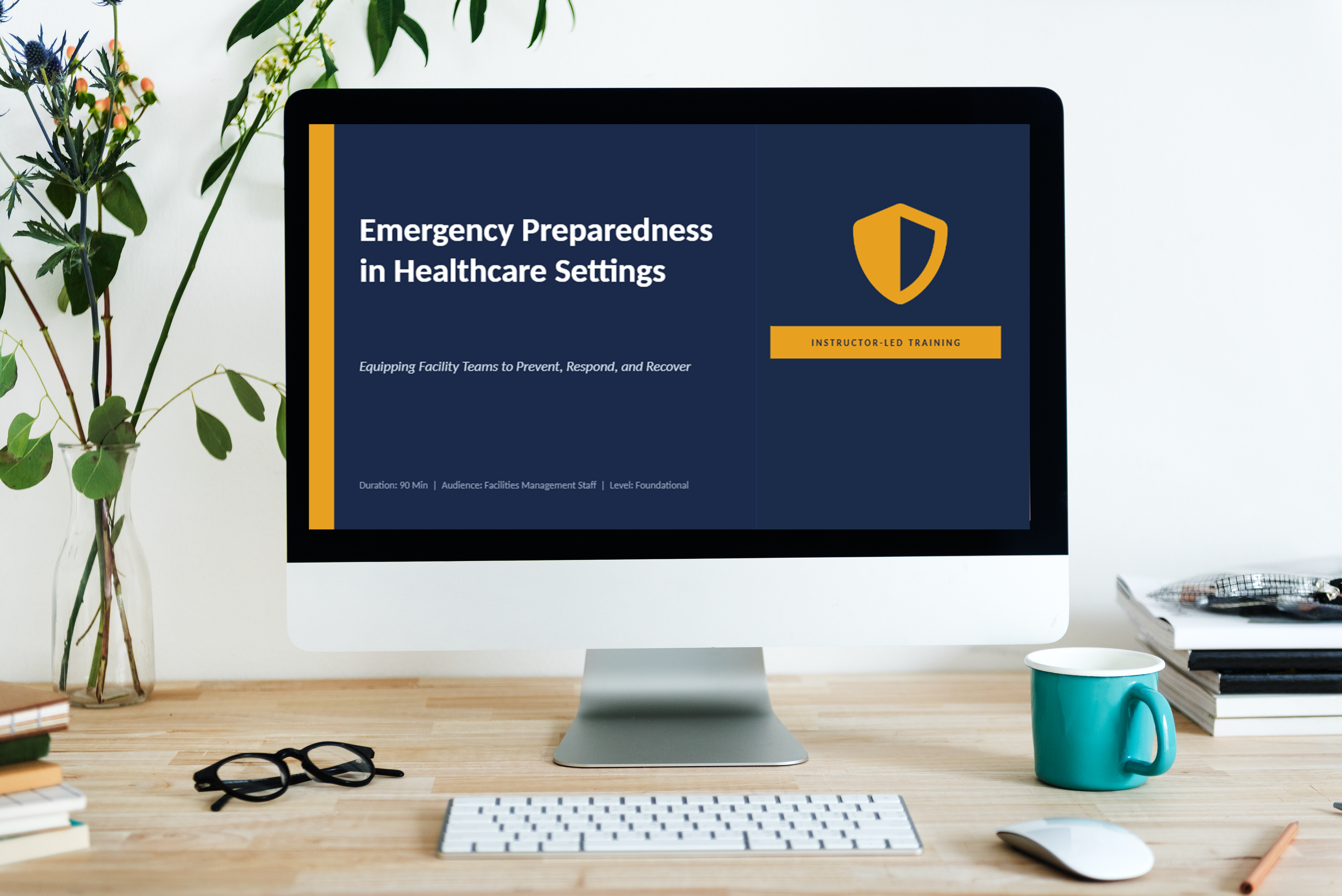
Instructor-led training course on Emergency Preparedness in Healthcare Settings, designed for frontline facilities management staff in acute care environments. The project demonstrates end-to-end ILT development including scenario-based learning, Bloom's-aligned objectives, Kirkpatrick evaluation strategy, and embedded instructor facilitation built on ADDIE and adult learning principles.
Audience: Facilities Management personnel
Duration: 90 minutes
Slide Count: 12
Design Tools Used: PowerPoint, Google Slides, Claude, Pixabay, Adobe Photoshop, SnagIt
ID Frameworks: ADDIE, Bloom’s Taxonomy, Adult Learning Principles
Key Deliverables: ILT slide deck with instructor notes, scenarios and knowledge check
Needs Analysis (Problem)
The target learners are frontline healthcare Facilities Management staff at the foundational level. The course addresses gaps in emergency decision-making by combining role-specific instruction, scenario-based practice, and knowledge checks aligned to ICS responsibilities and regulatory requirements.
Solution
The course closes this gap by building foundational knowledge, applying it through a scenario requiring decision-making, then reinforcing correct reasoning through debrief and a knowledge check.
Design Approach & ID Frameworks
The course follows ADDIE through audience analysis, objective-driven design, scenario-based development, and evaluation through knowledge checks and debrief activities.
Learning Objectives
Learning objectives were written at the appropriate Bloom’s level for a foundational, performance-focused course. Each objective maps to a specific slide or activity:
-
Regulatory Requirements Slide: CMS and TJC standards presented in structured card format
-
Four Phases Diagram Slide: visual flow with color-coded blocks and real-world examples
-
ICS slide: FM role callout box links abstract structure to learner’s daily context.
-
Scenario Slide: Learners evaluate situational cues to choose between evacuation and shelter-in-place
Adult Learning Principles (Knowles’ andragogical principles)
Problem Centered: The scenario requires learners to make a real-world decision before receiving feedback.
Role Relevant: Each module directly ties content to FM responsibilities within ICS operations.
Prior Experience: Instructor prompts activate prior knowledge before introducing new content.
Self-Direction: The Next Steps slide provides clear, actionable takeaways learners can immediately apply.
Content Strategy & Sequencing
Content builds progressively from foundational knowledge to applied decision-making, then closes with consolidation:
-
Establish the context, objectives, and agenda
-
Introduce the Four Phases, regulatory requirements, and ICS structure
-
Provide scenarios, debrief and assign knowledge check
-
Provide takeaways, next steps and Q & A
Key Design Decisions & Rationale
Scenario-Based Learning: Slide 7 places learners in a realistic fire emergency requiring clinical and procedural decision-making before the debrief reveals the correct response.
Instructor Hints : Three instructor prompts guide prior knowledge activation, discussion flow, and debrief reasoning beyond simply identifying the correct answer.
Cognitive Load & Visual Consistency: Visuals use simplified, color-coded layouts and a consistent design system to reinforce structure, reduce cognitive load, and support quick recall.
Evaluation
Kirkpatrick’s Levels 1-4 are addressed across the course:
-
Discussion moments (slides 4, 7) gauge engagement and relevance.
-
Knowledge Check (slide 9) assesses correct sequencing of emergency response and scenario debrief (slide 8) assess application of RACE/PASS logic.
-
Next Steps (slide 11) includes five observable actions learners can take within 48 hours. A post-assessment at 30/60 days could measure actual transfer.
-
In full deployment, evaluation could align to drill performance, compliance audits, and facility incident response outcomes.
Results & Takeaways
The main challenge was moving beyond policy summaries to focus on real decision-making under pressure. The scenario was designed around that performance gap, while the debrief reinforces clear, recallable actions. In a live rollout, I’d add a pre-assessment and follow-up tied to the facility’s EOP to strengthen transfer.